
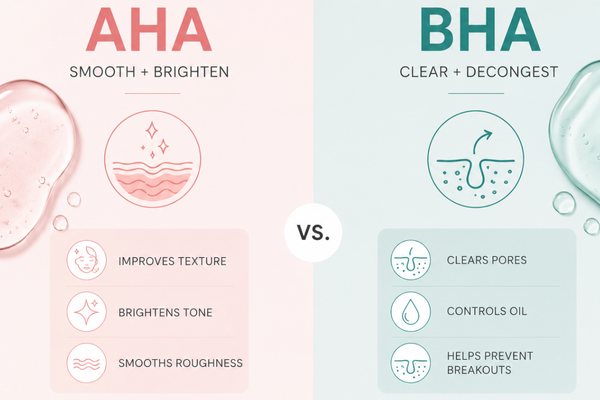
Two letters apart, and yet AHA vs BHA might be the most mixed-up debate in all of skincare. Both promise smoother, clearer, brighter skin. Both sit side by side on the shelf. And more often than not, people grab whichever one has the prettier label and hope for the best.
But these two acids aren’t doing the same job. Worse still, using the wrong one for your skin can mean months of underwhelming results or irritation you didn’t need to deal with.
Luckily, telling them apart isn’t complicated once you understand what’s happening underneath. In this post, we’ll clear up the difference between AHA and BHA, what each one does best, and how to land on the best exfoliant for skin like yours.
First, Why Exfoliate at All?
Your skin is constantly making new cells and shedding old ones. In theory, this happens on its own. In practice, dead skin cells love to overstay their welcome. When they linger, they pile up on the surface and make your skin look dull, feel rough, and trap oil and debris in your pores.
Exfoliation clears this layer away.
You can do it physically, with scrubs and tools, or chemically, with acids that loosen the “glue” holding dead cells together. Because chemical exfoliants tend to be gentler and more even than scrubbing, both AHA vs BHA exfoliants have earned a permanent spot in so many routines.
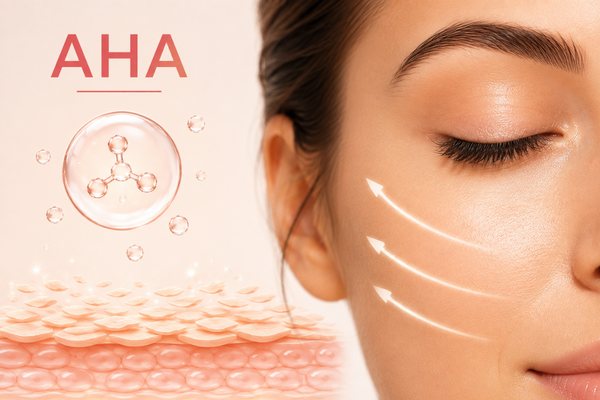
What Is an AHA?
AHA stands for alpha hydroxy acid, a family of water-soluble acids derived largely from fruits, milk, and sugar. The ones you’ll spot most often on labels are glycolic acid (from sugarcane) and lactic acid (from milk), along with a few others like mandelic and citric acid.
M.A.D Skincare harnesses AHAs to exfoliate, renew, brighten, and refine the skin. Glycolic acid, one of the most widely used AHAs, has a small molecular size, which lets it effectively exfoliate dead skin cell buildup and promote cell turnover. It helps improve the look of fine lines, uneven tone, discoloration, texture, and dullness.
Glycolic acid’s proven versatility makes it a key ingredient across M.A.D Skincare formulas.
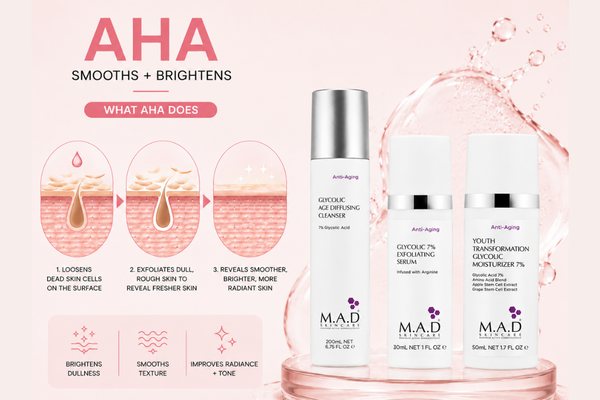
Single-Acid Glycolic Formulas
These formulas harness the power of glycolic acid to deliver focused, effective exfoliation at every step of your routine.
Our lightweight Glycolic 7% Exfoliating Serum pairs 7% Glycolic Acid with 1% sodium hyaluronate to exfoliate and replenish hydration. Glycolic acid helps minimize the appearance of fine lines, uneven tone, and dullness, while sodium hyaluronate attracts and retains moisture to promote plumper, more resilient-looking skin without clogging pores.
The Glycolic Age Diffusing Cleanser, powered by 7% glycolic acid, combines daily cleansing and exfoliation to sweep away dirt, impurities, and dead skin cell buildup for a fresh, radiant-looking complexion. SymGlucan®, derived from beta-glucan, conditions, moisturizes, and also helps improve the visible signs of environmental skin aging.
Finally, our Youth Transformation Glycolic Moisturizer 7% combines 7% glycolic acid, Prodew® 600 amino acids, shea butter, and plant stem cells to pair resurfacing with nourishing hydration. It helps refine the complexion and supports moisture and elasticity for soft, supple, more youthful-looking skin.
Multi-Acid AHA Blends
M.A.D Skincare also combines complementary AHAs within select formulas to offer a broader range of exfoliating and skin-enhancing benefits.
The Mandelic Refining Cleanser combines four AHAs: mandelic, lactic, tartaric, and malic acids, for multi-benefit cleansing and exfoliation. Mandelic acid targets pores and blemishes, lactic acid hydrates and smooths, tartaric acid boosts radiance, and malic acid refreshes uneven-looking tone.
The non-drying cleanser addresses multiple concerns, including blemishes, discoloration, dullness, and visible signs of aging.
Our Youth Transformation Exfoliating Serum 10% AHA combines 5% Glycolic Acid with Multifruit® BSC, a blend of naturally occurring AHAs from bilberry, sugar cane, sugar maple, orange, and lemon. Together, these acids exfoliate dead skin cell buildup and promote cell turnover to smooth texture, refine tone, boost radiance, and minimize the appearance of fine lines and wrinkles.
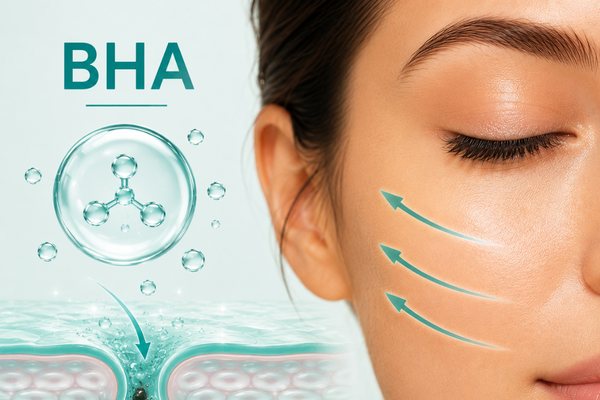
What Are BHAs?
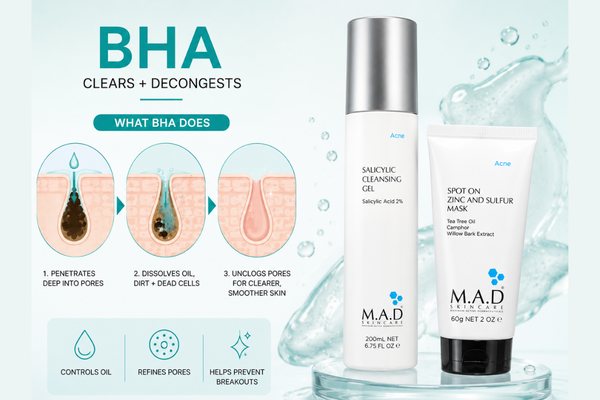
BHA exfoliants (Beta Hydroxy Acids) penetrate beneath surface oil to clear pore-clogging buildup. They’re especially beneficial for breakouts, blackheads, enlarged-looking pores, excess shine, uneven texture, and post-breakout marks. Salicylic acid, mainly derived from the bark of willow trees, is the most commonly used BHA in skincare. M.A.D Skincare’s Acne Concern features a range of formulas powered by salicylic acid.
Salicylic Acid Formulas
Powered by salicylic acid, the most widely used BHA, these formulas work below the surface to clear congestion and keep blemish-prone skin clean and balanced.
M.A.D Skincare’s Salicylic Cleansing Gel 2% puts the power of BHA exfoliation at the first step of your blemish-fighting routine. Formulated with 2% Salicylic Acid, this cleanser penetrates pores to help remove excess oil, dead skin cells, and pore-clogging buildup.
Oil-balancing botanicals and our Trinity Tea Complex complement the formula to leave oily, blemish-prone skin feeling clean, refreshed, balanced, and ready for the next step in your routine.
Our Spot On Zinc & Sulfur Mask combines willow bark extract and sulfur to target blemish-prone, congested skin. Willow bark extract, a natural source of salicin, helps gently exfoliate, calm the look of irritation, and reduce pore-clogging buildup, while sulfur helps absorb excess oil and clarify the skin.
Use as a targeted treatment or leave on overnight for clearer, calmer, more balanced-looking skin.
How to Choose the Right One for You
Start with your skin type and your biggest concern. These elements should drive your decision in the first place.
If you have dry, sensitive, or mature skin, an AHA is usually the friendlier starting point, especially lactic acid, since it exfoliates and helps your skin hold onto moisture.
If you have oily, acne-prone, or congestion-prone skin, opt for a BHA. Salicylic acid’s ability to get into the pores makes it uniquely suited for anyone who battles blackheads, breakouts, or oil.
If you have combination skin, you don’t necessarily have to choose. Some people use a BHA on oilier zones like the T-zone and an AHA elsewhere, though it’s worth easing into that rather than layering everything at once.
Can You Use Both?
Using an AHA and a BHA together can absolutely be effective, since they target different problems. The trick is to avoid overdoing it.
You can alternate days, using an AHA one night and a BHA the next. You can apply them at different times of day. Or you can look for a thoughtfully balanced product that includes both in sensible concentrations.
Whatever route you choose, ease in slowly rather than going all-in on day one.
The Bottom Line
When it comes to AHA vs BHA, these two aren’t rivals so much as specialists. AHAs resurface the top layer for smoother texture and a brighter tone. BHAs dive into your pores to tackle oil and breakouts. Once you know which problem you’re trying to solve, the choice gets a whole lot clearer.
Shop M.A.D Skincare’s collections today, and reveal smoother, clearer, brighter, healthier-looking skin.